
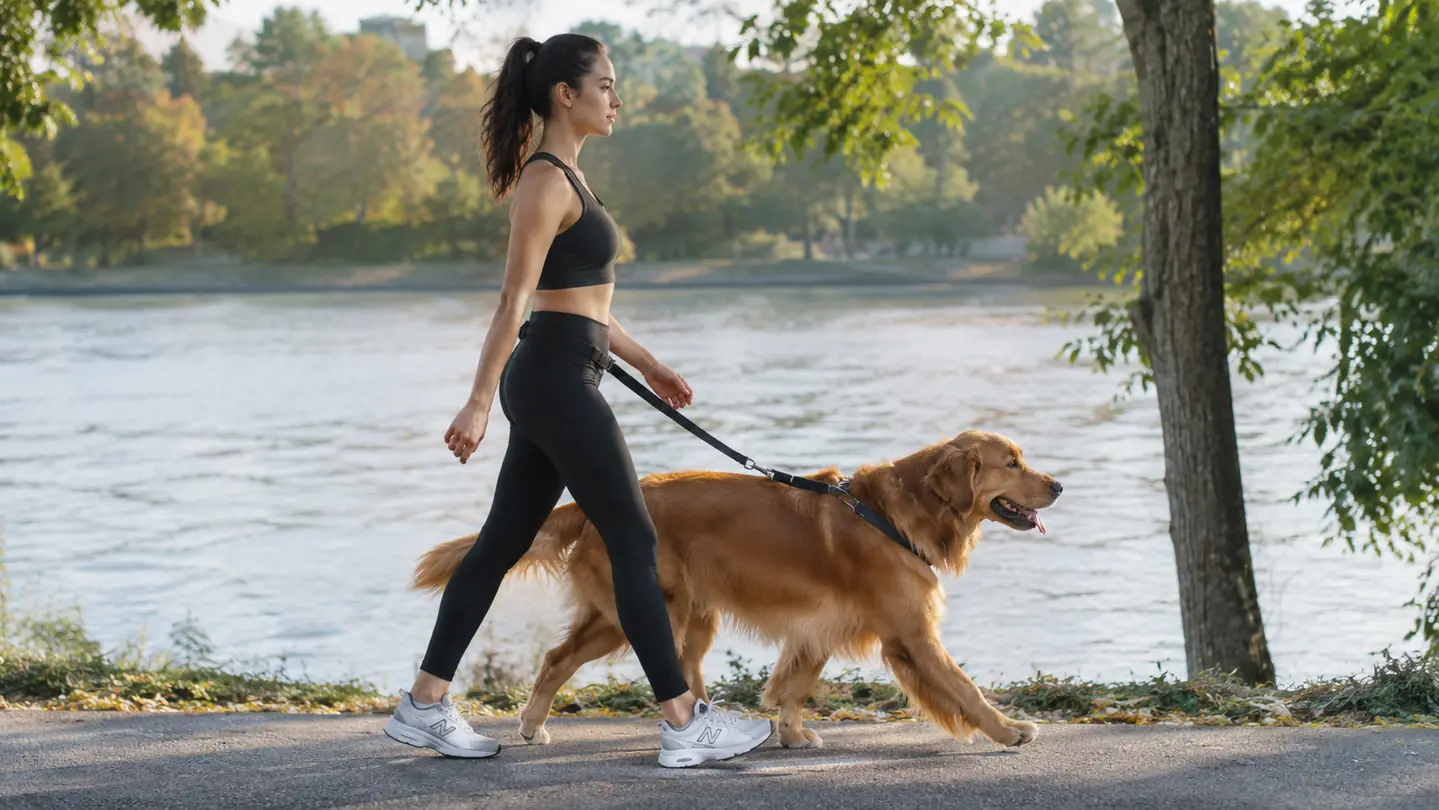
If your dog pulls, you already know the morning math. You want to walk four miles. Your shoulder wants to file a complaint by the first quarter mile. I am Odessa, a retired school nurse in Bend, Oregon, and I walk four to six miles most days with Juniper, my 7-year-old Australian shepherd mix, about 45 pounds. She is a good dog who turns into a sled dog the moment she sees a deer. For years I managed with a standard leash and a lot of bracing. Then I switched to the iYoShop hands-free dog leash, and the walks changed more than I expected.
This guide is the step-by-step version of what I did. It is not a promise that your dog will stop pulling in a week. It is a practical plan for making the pulling manageable, protecting your back and shoulder, and keeping both of you comfortable while you train. The iYoShop leash is the tool I use, and I will show you exactly how to set it up and walk with it.
Stop bracing against the leash on every walk
The iYoShop hands-free leash puts the pull at your waist instead of your shoulder, with a zipper pouch for keys and poop bags. See today's price on Amazon.
Amazon Check Today's Price on Amazon →Step 1: Set the waist belt snug, not tight
The first mistake people make with a hands-free leash is wearing the belt like a fashion accessory. If it hangs loose on your hips, every pull from the dog twists the belt and turns the padding into a rope burn. If you cinch it too tight, you trade a shoulder problem for a hip problem. I learned this the hard way on a cold Tuesday in March, my first morning with the belt, when I left it loose and Juniper spotted a deer within the first hundred yards. The belt spun halfway around my waist and the clip dug into my hip bone. I stopped, unbuckled, and started over.
I put the iYoShop belt over my jacket or vest, high enough that it sits on my natural waist, and I pull it snug enough that I can slide two fingers under the padding. That is the same fit I used for a blood pressure cuff, and it works here. The belt has a buckle and a clip, so I can adjust it while wearing it, which matters when I add a fleece in the morning and take it off by noon. On days when the temperature swings from 28 to 55 degrees, which happens often in Bend in the spring, I adjust the belt twice on the same walk.
One note from my first week: the belt is part of the leash system, not a separate accessory. The leash clips to the belt with a carabiner, and the whole thing stays together in the drawer. I do not have to hunt for pieces before a walk. I keep it on a hook by the back door, belt buckled, leash clipped, pouch zipped, so I can grab it with one hand while Juniper does her excited circle at my feet.
Step 2: Clip the leash to the front ring, not the side
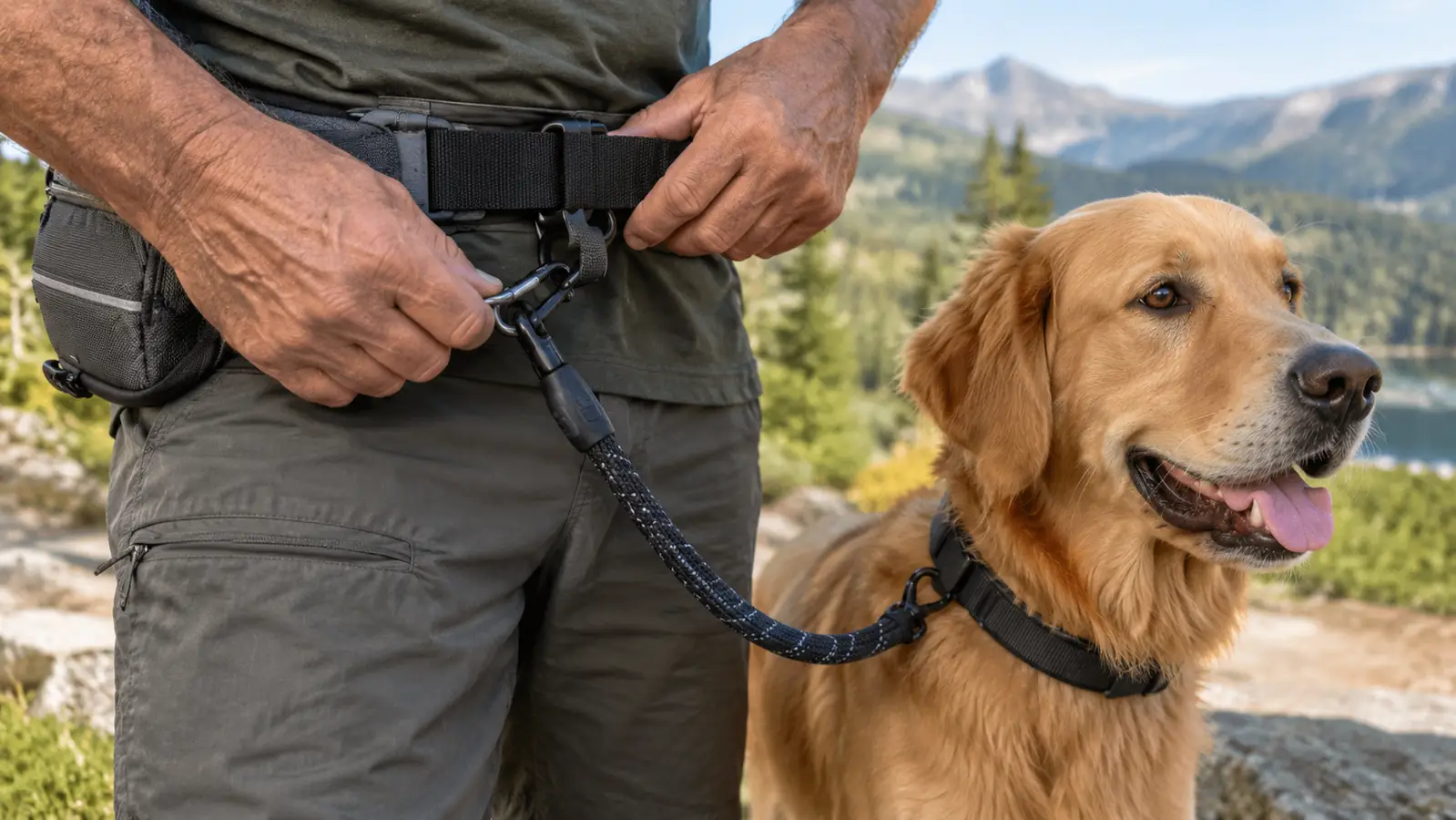
The iYoShop leash has a clip on one end for the belt and a handle on the other end for your hand. Most people clip the leash to the belt ring on their hip and call it done. That works, but I found a better setup for a puller. For the first few days I used the hip ring because it felt natural, like carrying a bag. Every time Juniper lunged, the pull twisted my whole torso and I found myself walking sideways for a step or two. My lower back complained by the end of the first mile.
I clip the leash to the ring at the front of the belt, centered over my belly button. When Juniper surges, the pull comes straight at my center of gravity instead of twisting me sideways. I can stand my ground without fighting the rotation. The leash also stays out from under my feet, which was my biggest worry when I started. With the clip at the front, the leash hangs down between my legs in a gentle curve, and I have never once tripped on it, even when Juniper crosses from my left side to my right to sniff a bush.
The handle end stays in my left hand as a backup. I do not grip it. I let it rest in my palm so I can grab it fast if a cyclist comes up behind us or if Juniper locks onto a squirrel. Most of the time my hand is free, but the handle is there when I need it. On a typical two-mile walk, I probably close my fingers around it for a total of two minutes, mostly at road crossings and when we pass other dogs.
Step 3: Use the traffic handle for close control
The iYoShop leash has a second handle closer to the dog, sometimes called a traffic handle. I ignored it for the first two weeks because I did not see the point. Then a truck backfired on the river path and Juniper bolted. I grabbed the traffic handle, and it gave me close control without yanking her neck. That was a Saturday morning around 7:15, and I remember thinking that the handle had just paid for itself in one second.
Now I use it on purpose. When we cross a street, pass another dog, or walk through a narrow gate, I slide my hand down to the traffic handle and keep Juniper close to my leg. The waist belt still carries her weight if she lunges, but the short grip keeps her from getting any momentum. I also use it on the river path when we meet a cyclist, because a 45-pound dog moving at full speed can knock me off balance even with the belt doing the heavy work.
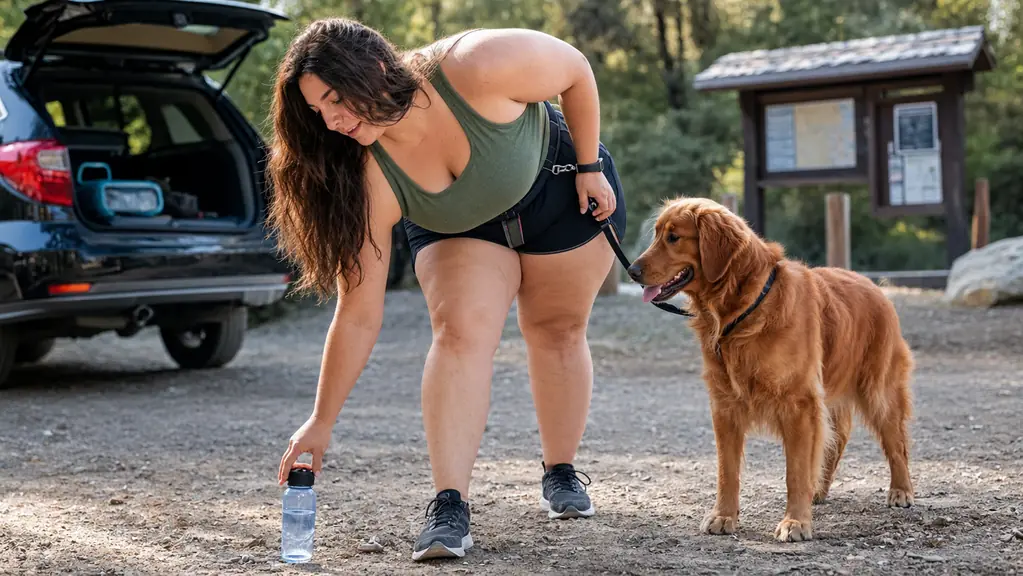
This is also the handle I use when I need to bend down. I can pick up a dropped glove or tie a shoe while the leash stays attached to my waist, and Juniper stays within a small circle instead of wandering into the road. Last month I dropped my keys at the trailhead, bent over to get them, and Juniper did not move. With a regular leash, that moment would have meant wrapping the strap around my wrist or letting her drag me. With the iYoShop leash, it was a non-event.
Step 4: Stop walking when the leash goes tight
Here is the part nobody wants to hear: the leash does not train the dog. You do. The iYoShop leash makes the training easier because it takes your shoulder out of the equation, but you still have to teach your dog that pulling does not get them where they want to go. I say this because I have seen people buy a new leash and expect the dog to read the manual. It does not work that way, and I do not want you to waste a week the way I almost did.
The method I used is simple. The moment the leash goes tight, I stop. I do not yank, I do not scold, I just stop and stand still. Juniper looks back at me, confused. I wait. The second she gives slack, I say good girl and we move again. At first we stopped every twenty feet. I counted on the first day out of curiosity: 47 stops in the first mile. By the third week, we stopped maybe twice on a two-mile walk. The change was not instant, but it was steady.
The waist belt makes this tolerable. With a hand-held leash, stopping and starting a hundred times a day wore out my arm and my patience. With the iYoShop leash, the pull is at my waist, my hands stay relaxed, and I can wait as long as it takes without getting sore. That is the real advantage, and it is why the training actually stuck. I also found that standing still with my hands free made me calmer, and Juniper picked up on that. Dogs read your body, and a relaxed handler is a lot more convincing than a frustrated one.
Step 5: Build up to longer walks and add the pouch
Once Juniper understood that tight leash means stop, we could start covering real distance. I built up gradually, adding half a mile each week. The iYoShop leash is rated for dogs from 25 to 120 pounds, and Juniper at 45 pounds is well within that range. The belt padding stayed comfortable even on our four-mile days. By the end of the second month, we were doing our usual four to six miles again, and my shoulder stopped aching after walks for the first time in years.
The zipper pouch on the belt turned out to be more useful than I expected. I keep my house key, a phone, and a roll of poop bags in it. I do not have to carry a bag or stuff things in my jacket pockets. The pouch is big enough for a small water bottle, though I usually carry a larger one in a backpack on hot days. On a warm afternoon in July, I put a 12-ounce bottle in the pouch and it stayed put for the whole three-mile loop, which surprised me.
A few practical notes from months of use. The leash is long enough for Juniper to sniff and explore, but I keep it short when we pass other dogs. The clip is metal and has held up fine through rain, snow, and the occasional dunk in a puddle. I have not had a single failure in six months of daily use. I have washed the belt by hand twice, once after a muddy trail day, and it dried overnight without losing its shape.
What Else Helps
The iYoShop leash did most of the work, but a few other things made the walks easier. I switched Juniper to a front-clip harness for training days, which gives me more steering than a collar. I walk her before breakfast when she has the most energy to burn. And I carry high-value treats in the zipper pouch, small pieces of chicken, so I can reward the exact moment she gives slack. The pouch is right at my waist, so the treat is always within reach without fumbling in a pocket.
I also learned to read the environment. Juniper pulls hardest when she sees deer, so I stay alert on the river path at dawn. When I spot a deer before she does, I shorten the leash, move to the side, and ask her to sit until the deer moves on. The hands-free setup makes this easier because both my hands are free to manage the situation. I can hold a treat in one hand and the traffic handle in the other, and Juniper gets the message that sitting still is the way to earn the reward.
The first week we stopped every twenty feet. By the third week, maybe twice on a two-mile walk. The waist belt is why the training stuck.
Give your shoulder a break and your dog a better walk
The iYoShop hands-free dog leash with zipper pouch is the tool I reach for every single day. Check today's price on Amazon and see if it fits your dog's size range.
Amazon Check Today's Price on Amazon →