
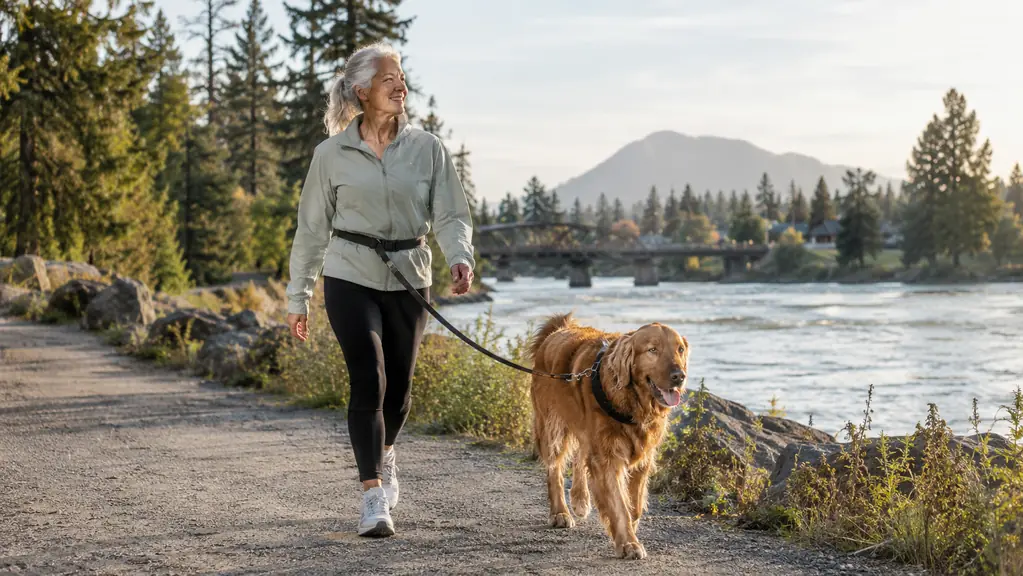
I have been walking Juniper, my 7-year-old Australian shepherd mix, for four to six miles most days for the past three years. My knees are not what they used to be, and neither is my patience for gear that promises convenience and delivers a tangle. So when I ordered the iYoShop hands-free dog leash, I expected the usual compromise: a waist belt that rides up, a bungee that snaps, a pouch too small for a phone. What I got surprised me, and what nobody tells you about this leash is that the surprises are mostly good, with a few honest exceptions.
I have used this leash for over four months now, through Oregon rain, a stretch of 90-degree afternoons, and enough deer sightings to make Juniper forget every training cue she ever learned. This is the review I wish I had read before I bought it, the one that tells you what it is actually like to live with, not just what the listing photos show.
The Quick Verdict
The iYoShop hands-free dog leash is the rare piece of walking gear that makes my daily miles genuinely easier, as long as you understand its limits before you buy.
Amazon Check Today's Price →The hands-free leash I reach for every single morning
After four months of daily use, the iYoShop hands-free dog leash is the one I keep coming back to. It holds Juniper's pulls, carries my phone and keys, and lets me walk with my hands free.
Amazon Check Today's Price on Amazon →How I've Used It
I walk Juniper on the Deschutes River trail most mornings, and on weekends we drive to easy Cascade trailheads in my small SUV. That means this leash has seen pavement, gravel, packed dirt, and the occasional muddy stretch. Juniper is about 45 pounds and she pulls hard when she sees deer, which in Bend is almost every single walk.
I wore the iYoShop leash around my waist for all of those walks. I put my phone in the zipper pouch, my keys in the small pocket, and a poop bag in the side slot. I did not carry a water bottle in the pouch, because I do not think it is built for that, and I will explain why in a moment.
The first thing I noticed was how different it feels to walk with both hands free. I could carry a coffee cup, adjust my hat, answer a quick text, or just let my arms swing the way they do when I walk alone. That sounds small, but after a few weeks it changed the rhythm of my mornings.
One morning in late September, I left the house without the leash by mistake. I had clipped Juniper to her old flat leash out of habit, and within half a mile I was back to the familiar routine: leash wrapped around my wrist, coffee sloshing, hat crooked, one hand constantly adjusting. That walk took twenty minutes longer than usual because I kept stopping to untangle us. It was the clearest proof I have had that the iYoShop leash is not a gadget I reach for out of novelty. It is the tool that makes the walk work.
What Nobody Tells You About the Waist Belt
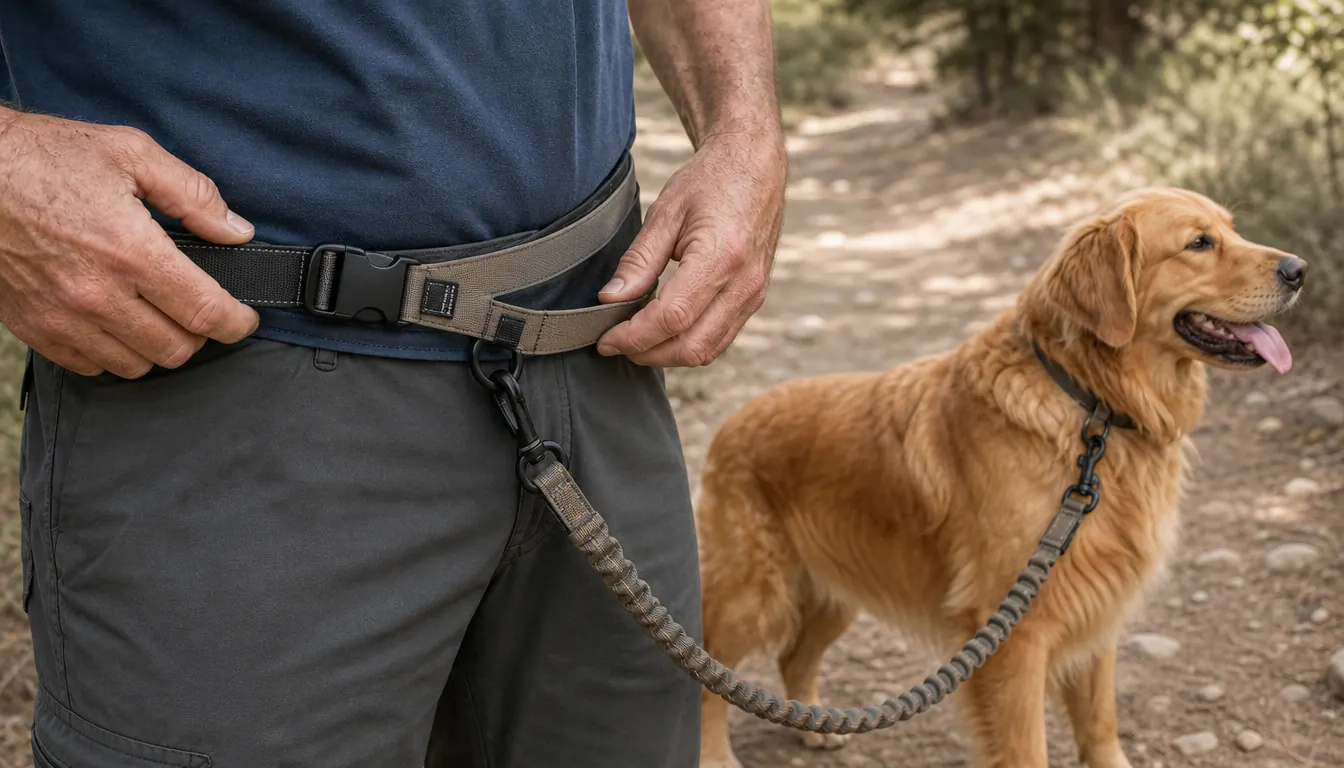
The iYoShop waist belt is the part of this leash that most reviews skip, and it is also the part that matters most. It is a wide, padded belt that sits low on your hips, not up around your natural waist. That placement is deliberate. When Juniper lunges at a deer, the force hits my hips instead of my lower back, and that has made a real difference for my knees and my back.
The belt has a buckle that is easy to open one-handed, which matters when you are holding a leash in one hand and a coffee in the other. It also has a clip on each side, so you can attach the leash to either hip. I mostly use the left clip, because Juniper walks on my left, but I have switched sides on narrow trails when I wanted her on the other side.
Here is what nobody tells you: the belt will ride up if you do not tighten it enough. The first two weeks, I kept it loose because it felt more comfortable, and I spent those two weeks tugging it back down every few minutes. Once I tightened it so it sat snugly on my hip bones, it stayed put for the rest of the walk. That one adjustment made the biggest difference.
There is a second detail I did not see in any listing. The belt has a small D-ring on the front, and I assumed it was for attaching a key ring or a treat pouch. I tried clipping a small treat pouch to it on a Saturday morning walk, and the pouch swung and bounced the entire time. I moved the pouch to the side clip instead, and that worked much better. The D-ring is fine for something light, but it is not a stable attachment point for anything with weight. That is the kind of thing you only learn by wearing the belt for a few weeks.
I also learned that the belt fits differently over different layers. In September I wore it over a thin jacket and it sat exactly where I wanted it. In November, with a puffy coat, I had to let the belt out one notch and re-tighten it after the first mile, because the padding compressed and the belt loosened. That is a small thing, but it is the kind of detail that only shows up when you wear the same belt through a change of seasons.
The belt rides up if you leave it loose. Tighten it so it sits on your hip bones, and it stays put for the whole walk.
The Bungee: What It Does and What It Does Not Do
The leash itself is a bungee, which means it stretches when Juniper pulls and then gently brings her back. I was skeptical of this at first. I have used flat leashes my whole life, and I assumed a bungee would either be too springy or too stiff. The iYoShop bungee is somewhere in the middle, and that middle is exactly right for a dog like Juniper.
When she sees a deer, the bungee absorbs the first part of the lunge instead of jerking my hip forward. That gives me a second to brace myself and shorten the leash with my hand. It does not stop the pull, and I want to be clear about that. No leash stops a determined 45-pound dog from pulling. What it does is make the pull less jarring and easier to manage.
The bungee also means there is always a little slack in the line, which took me a while to get used to. On a flat leash, you feel every step your dog takes. On this one, Juniper can drift a few feet ahead without me feeling it, and I have to pay more attention to where she is. That is not a flaw, but it is a real adjustment.
I tested the stretch on purpose one afternoon on the river path. I stood still, let Juniper get to the end of the line, and watched how far the bungee extended before it stopped. It stretched roughly two feet beyond its resting length, then held firm. That told me two things. First, the bungee has real give, which is what makes the initial lunge survivable. Second, it does not keep stretching forever, which is what I want, because a bungee with no limit would let her build up speed before the line caught. The stopping point is firm, and that firmness is what lets me keep control on the downhill sections.
One thing I did not expect is how the bungee behaves when Juniper is walking calmly. On a flat leash, a loose line drags on the ground and picks up mud. On this leash, the bungee keeps a gentle tension even when she is walking at my side, so the line stays off the pavement. After a rainy October walk, I checked the bungee and it was almost clean, while her old flat leash would have been streaked with grit. That is a small convenience, but it is one I notice every single week.
The Zipper Pouch: Better Than I Expected, With One Catch
The zipper pouch on the iYoShop leash is bigger than I expected. My phone fits easily, and so do my keys, a small wallet, and a roll of poop bags. The zipper is smooth and has not jammed once in four months, which is more than I can say for some jackets I own. The pouch sits at the front of the belt, so it is easy to reach without taking the belt off.
The catch is the water bottle holder. There is a small mesh pocket on the side, and it will hold a small bottle, but it is not stable. When I tried walking with a full water bottle in it, the bottle bounced against my hip with every step and eventually worked its way loose. I stopped using it after the second walk. If you need to carry water, bring a backpack or a bottle with a clip.
I also want to be honest about the pouch in the rain. The main zipper is not waterproof. A light drizzle is fine, but a real Oregon downpour will eventually find its way in. I keep my phone in a ziplock bag when the forecast is wet, and that has solved the problem completely.
One more thing about the pouch: it changes how I pack for a walk. Before this leash, I carried a small crossbody bag with my phone, keys, and a separate pouch for dog treats. Now I put the phone in the zipper pouch, the keys in the small front pocket, and a few treats in the same pocket. That is one less bag to remember, and one less strap fighting with the leash. On a Tuesday morning when I am trying to get out the door before the rain starts, that simplicity matters more than I expected.
I measured the pouch one afternoon out of curiosity. My phone is about six inches long, and it fits with room to spare, and my key ring drops in beside it without a struggle. The small front pocket is just deep enough for a folded poop bag roll and a handful of treats. The measurements are not printed anywhere on the listing, so I had no idea the pouch was this usable until I tried it. That is the kind of information I wish someone had given me before I ordered.
How It Held Up Over Four Months
I have put this leash through more than a hundred walks, and it shows almost no wear. The stitching on the belt is intact, the buckles still click cleanly, and the bungee has not lost its stretch. I wash the belt by hand every few weeks with mild soap and water, and it dries quickly.
The one thing I watch is the clip that attaches the bungee to the belt. It is a standard metal clip, and it has held up fine, but I check it before every walk out of habit. That is not a criticism of this leash specifically. It is what I do with any piece of gear that connects me to my dog.
The reflective stitching on the belt is still bright, which matters to me because I walk in the early morning when it is still dark. I have had drivers see me sooner on the river path, and that alone has made this leash worth keeping.
I did have one small scare in early November. I had clipped Juniper to the side clip and bent down to tie my shoe, and the clip released from the belt. It did not break. The clip had not been pushed all the way into the buckle, so a slight angle popped it loose. Since then, I make a point of listening for the click when I attach the leash, and I have not had it happen again. That is worth knowing, because it is the kind of thing that would not show up in a listing photo.
The bungee has also held its color and its stretch through the rain. I was worried the constant damp of October would make the fabric stiff or the stitching fray, but it has not. I dry the belt on a hook by the back door when we come in wet, and it is ready again by the next morning. That routine has kept the leash looking almost new, and it is the same routine I used with my old flat leash, so it did not add any work to my day.
What I Liked
- The padded waist belt redirects pulling force to my hips instead of my lower back, which has made a real difference for my knees and back.
- The bungee absorbs the first part of a lunge, giving me a second to brace myself before I shorten the leash by hand.
- The zipper pouch is genuinely useful: my phone, keys, a small wallet, and a roll of poop bags all fit, and the zipper has not jammed in four months.
- The belt stays put once you tighten it to sit on your hip bones, and the reflective stitching is still bright after a hundred-plus walks.
- The buckle opens one-handed, which matters when the other hand is holding a coffee cup.
Where It Falls Short
- The side mesh pocket is not stable enough for a full water bottle; it bounced against my hip and worked its way loose.
- The main zipper is not waterproof, so I keep my phone in a ziplock bag when rain is in the forecast.
- The bungee always has a little slack, so Juniper can drift a few feet ahead without me feeling it, and I have to watch her more closely.
- The front D-ring is not a stable attachment point for anything with weight; a treat pouch swung and bounced the whole walk.
- The clip can release if it is not pushed all the way into the buckle, so I listen for the click every time I attach the leash.
Who This Is For
This leash is for people who walk their dog every day and want their hands back. It is for runners who want to keep their stride, for people with back or knee trouble who want the pull redirected to their hips, and for anyone who is tired of wrapping a leash around their wrist a dozen times per walk. If you walk a dog in the 25 to 120 pound range, the iYoShop hands-free dog leash is worth a serious look.
Who Should Skip It
Skip this leash if your dog is a serious, constant puller who never relaxes on a walk. The bungee will not fix that, and you will spend the whole walk being towed. Skip it if you need to carry a full water bottle on your belt, because the side pocket is not up to that job. And skip it if you want a leash you can clip to your wrist, because this is a waist leash, full stop.
My honest verdict after four months of daily walks
The iYoShop hands-free dog leash is not perfect, but it has made my daily miles easier in a way I did not expect. If you walk a medium or large dog and want your hands back, this is the one I would buy again.
Amazon Check Today's Price on Amazon →