

I bought my TrailBuddy trekking poles the way most people do: I read the reviews, I liked the price, and I hoped they would make my knees feel better on the downhill. That was over a year ago. Since then they have been on roughly four hundred miles of town paths and easy Cascade trails with me and my dog Juniper, and I have opinions now that the five-star reviews do not mention. This is the honest review I wish I had read before I clicked buy.
A little context so you know where I am coming from. I am Odessa, a retired school nurse in Bend, Oregon. I walk four to six miles most days, partly for my own knees and heart and sleep, and partly because Juniper, my seven-year-old Australian shepherd mix, will not let me skip a day. I am not a mountaineer. I am not training for anything. I am a sixty-one-year-old woman who wants to keep walking without my hips complaining about it afterward. If that sounds like you, keep reading, because most of what I have to say applies to exactly that kind of walking.
The Quick Verdict
TrailBuddy trekking poles are a genuinely good buy for everyday walkers and easy trail hikers who want balance support without spending a fortune. They are not the stiffest or the lightest poles you can own, and the twist locks need a firm hand, but after a year of daily use mine still work like the day they arrived.
Amazon Check Today's Price →Want the poles I have walked 400 miles with?
After a full year of daily use, my TrailBuddy poles are still going strong. If you want the same pair, check today's price on Amazon and read the current reviews before you decide.
Amazon Check Today's Price on Amazon →How I've Used Them
I want to be clear about what my testing did and did not involve. I did not climb a fourteener. I did not thru-hike the Pacific Crest Trail. I used these poles the way most people actually use poles: on flat paved river paths in the morning, on gravel trails with gentle grades, on a few rocky sections where I was glad to have them, and on one memorable weekend when a wrong turn added three extra miles and my knees were very happy I had not left them in the car.
My routine is simple. Most mornings I drive my small SUV to the river trailhead, leash up Juniper, and set out with the poles in my hands. On weekends I go a little farther into the foothills. I have used them in light rain, in wind, on packed snow, and in the kind of mud that makes you grateful for a third point of contact. I have also used them on flat pavement, which is where I learned something important: these poles help on flat ground too, just in a different way. They keep my posture honest and give my arms something to do, and on days when my lower back is tight, that makes a real difference.
The poles came with a few extras I did not expect: mud baskets, snow baskets, and rubber feet for walking on hard surfaces. I will be honest, I thought the rubber feet would be a gimmick. They are not. On pavement, the carbide tip alone is loud and a little slippery on smooth concrete. The rubber foot snaps on in seconds and turns the pole into something that feels like a walking stick. I use them every single time I walk the river path, and I have worn down one set of rubber feet in a year. That feels like reasonable wear.
What Nobody Tells You About the Twist Locks
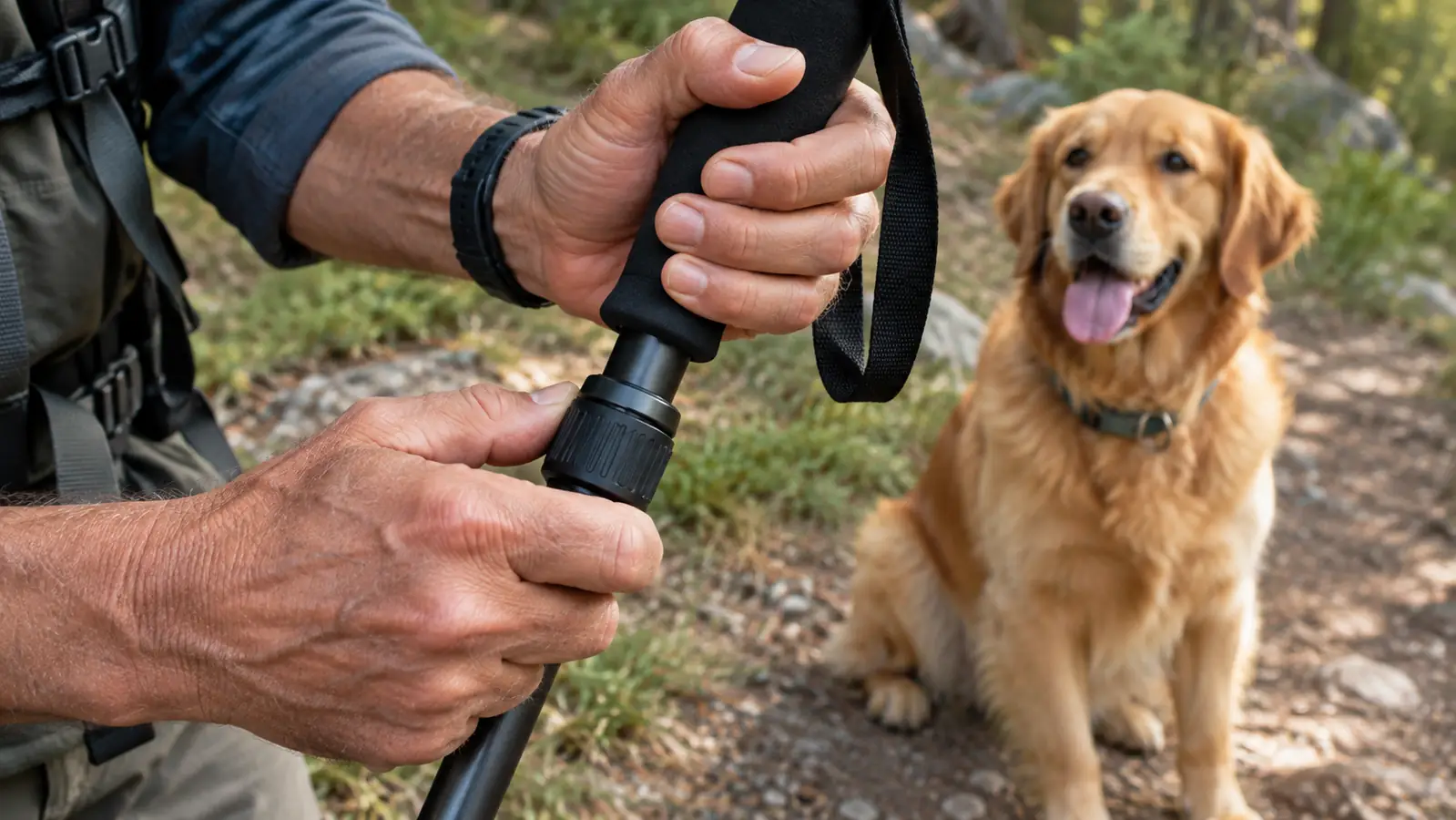
Here is the thing the reviews do not prepare you for: the twist locks need a firm hand, and they need to be checked. The TrailBuddy poles use a twist-lock system to adjust the length, and when you get it right, the pole is solid. When you do not get it right, the lower section can slip while you are putting weight on it. That happened to me exactly once, on a rocky downhill, and it was enough to teach me the habit of giving each section a firm twist and a quick push-down test before I start walking.
The fix is simple and it becomes automatic fast. After you twist the collar closed, push down on the pole with your body weight. If it holds, you are good. If it slips, open the collar, give it another quarter turn, and try again. I do this now without thinking, and I have not had a slip since. I mention it because a lot of the one-star reviews on these poles are from people who did not realize the locks need that firm hand. It is not a design flaw. It is a feature of twist locks in general, and TrailBuddy's are no worse than any other twist-lock pole I have tried.
The one-star reviews on these poles are mostly from people who did not realize the twist locks need a firm hand. Give them a solid twist and a push-down test, and they hold.
The Details That Matter on a Long Walk
Let me walk you through the specifics, because the details are what separate a pole you reach for every day from one that lives in the trunk. The TrailBuddy poles are made of 7075 aluminum, which is the standard alloy for hiking poles in this price range. They are not carbon fiber, so they are not the lightest poles you can buy, but they are light enough that I do not notice them in my hand, and they are noticeably more forgiving of the kind of bumps and drops that happen when you walk a dog who lunges at a deer.
The grips are cork, which was the detail that surprised me most. I expected cheap foam. Instead, the cork grips have shaped finger indents that fit my hand well, and they do not get slippery when my palms sweat on a warm morning. They also do not get cold the way rubber grips do on a frosty day. After a year, the cork has compressed a little where my thumb rests, but there are no cracks and no fraying. For the price, that is better than I expected.
The wrist straps are worth a mention too. They are padded and adjustable, and they are designed so you can push down through the strap without gripping the pole tightly. That is the correct way to use trekking poles, and it took me a few weeks to get the hang of it. Once I did, I noticed my hands were less tired and my shoulders were less tight. The straps also mean that if Juniper lunges after a squirrel, the pole does not go flying. It just dangles from my wrist while I tell her to settle down.
How They Perform on Different Surfaces
I keep a mental scorecard for each surface I walk on, because a pole that is great on dirt can be terrible on pavement. On packed dirt and gravel, the carbide tip bites in nicely and gives you a solid push. On loose rock, the tip finds the gaps and gives you stability you simply do not have with two legs alone. On packed snow, the snow baskets keep the tip from sinking too deep, and I was grateful for them on the few icy mornings we had this winter. On wet wood bridges, the carbide tip is actually a little too grippy, which sounds like a good thing until you catch a tip in a gap between planks. I learned to lift the poles slightly on boardwalks and bridges.
On pavement, the rubber feet are essential. Without them, the carbide tip clicks loudly with every step and can skid on smooth concrete. With them, the poles are quiet and stable, and they give me the same posture support I get on the trail. I will say plainly that if you plan to use these poles mostly on sidewalks, you should budget for replacing the rubber feet every six to twelve months depending on how much you walk. They are inexpensive and easy to find, but they are a wear item, and nobody tells you that in the reviews.
What I'd Change If I Could
No review is honest without a complaints section, so here is mine. First, the twist locks, which I already covered, are the steepest learning curve. They are not hard, but they are not as foolproof as the flip locks on some other poles. Second, the poles are three pieces, which means they collapse down to a nice compact size for travel, but it also means more joints to check and occasionally retighten. Third, the included carrying bag is basic. It does the job, but the zipper feels like the weakest part of the whole package, and I would not trust it to survive years of hard travel.
The fourth thing is more of a note than a complaint. The poles are adjustable from roughly 24 to 54 inches, which covers my height fine, but if you are very tall, over about six foot two, you may find yourself near the top of the adjustment range. I am five foot six and I use them in the middle of the range, so this is not something I dealt with personally. I mention it because the reviews are full of tall people asking about it, and the answer is that it depends on your exact height and arm length. If you are very tall, measure your ideal pole length before you buy.
What I Liked
- Cork grips with shaped finger indents stayed comfortable on warm mornings and frosty ones alike
- Carbide tips bite into dirt, gravel and packed snow, and the rubber feet make pavement walking quiet and stable
- Three-section design collapses to about 24 inches, which fits in a suitcase and came through two road trips and a flight without damage
- Mud baskets, snow baskets and rubber feet all come in the box, so there is nothing else to buy before your first walk
- After roughly 400 miles and a full year of daily use, the locks, tips and straps still work like new
Where It Falls Short
- Twist locks need a firm hand and a push-down test before every walk, or the lower section can slip under weight
- Aluminum build is not the lightest option, and ultralight backpackers will feel the difference on long days
- The included carrying bag is basic and the zipper feels like the weakest part of the package
- Rubber feet are a wear item and will need replacing every six to twelve months if you walk mostly on pavement
Who This Is For
TrailBuddy trekking poles are for the person who walks most days and wants their joints to feel better afterward. They are for the person who is a little unsteady on uneven ground and would rather have a third point of contact than a fall. They are for the person who wants a solid, dependable pair of poles without spending two hundred dollars on carbon fiber they do not need. If you are a weekend hiker, a daily walker, a person recovering from a knee or hip issue, or a senior who wants to stay steady on the trail, these poles are a very reasonable choice.
They are also a good choice for people who travel. The three-section design collapses down to about 24 inches, which fits in a suitcase or a duffel bag, and the included carrying bag keeps the straps from tangling with everything else. I have taken mine on two road trips and one flight, and they came through both without a scratch. For the price, that kind of versatility is hard to beat.
Who Should Skip It
If you are a serious ultralight backpacker counting every ounce, these are not the poles for you. They are aluminum, not carbon, and you will feel the difference on a twenty-mile day. If you are a hardcore trail runner who needs poles that deploy instantly, the twist locks will frustrate you. And if you are someone who will not read the instructions and will not give the locks a firm twist, you will probably write a one-star review about slipping poles. That is on you, not on the poles.
I would also say that if you have a specific medical condition that affects your balance or your grip strength, you should talk to your doctor or a physical therapist before relying on any trekking pole. A pole is a tool, not a medical device. It helped my knees feel better on the downhill, but I am not going to promise it will do the same for you, because I am a nurse, not a magic fix worker, and everybody's body is different.
How They Compare to the Alternatives I Tried
I have tried a few other poles over the years, so I can give you a little context. A friend loaned me her carbon fiber poles once, and yes, they were lighter. They were also three times the price, and I did not notice the weight difference enough to justify it. I have also tried a cheap pair with foam grips and a flimsy locking mechanism, and those were a waste of money. The TrailBuddy poles sit in a sweet spot: they are light enough for daily use, sturdy enough for real trails, and priced so that you do not feel like you need to baby them.
The closest comparison I can make is to a good pair of walking shoes. You do not need the most expensive shoes to walk comfortably, but you do need shoes that fit well and hold up. The TrailBuddy poles fit my hand well, they hold up, and they do not make me feel like I am carrying equipment. They just make the walk easier. That is the whole job, and they do it.
One Small Habit Worth Starting
Here is the one habit that made the biggest difference for me with the TrailBuddy poles, and nobody mentions it. Once a week, usually on Sunday evening, I wipe both poles down with a damp cloth, open each lever, check that no grit is caught in the clamp, and close it again. It takes two minutes. Cinder dust from the trails around Bend gets everywhere, and a little grit in a lock is how a pole starts slipping. Two minutes a week has kept mine working like new.
Ready to make your daily walk a little easier?
After a year of daily use, I still reach for my TrailBuddy poles every morning. If that sounds like what you are looking for, check today's price on Amazon and see what other walkers are saying.
Amazon Check Today's Price on Amazon →